Announcement of the Shortlist for the
2026 Queen Sofía Spanish Institute Translation Prize
The Queen Sofía Spanish Institute (QSSI) announces the shortlist for the 2026 Queen Sofía Spanish Institute Translation Prize, a $10,000 award for the best English translation of a work originally written in Spanish. The Prize is currently the largest prize in the world for Spanish to English translators.
The ceremony will take place at the New York University Espacio de Culturas (NYU KJCC), 53 Washington Square S, New York, NY 10012, on Thursday, November 19th at 6:30pm.
Join us for the announcement of the winners and for a conversation about the winning translations followed by a Q&A.
After the ceremony you are invited to join us for a Spanish cocktail hour.
The 2026 Translation Prize
November 19th at 6:30 PM
Espacio de Culturas at NYU
53 Washington Square South, New York, NY 10012

Shortlist for the 2026 QSSI Translation Prize:
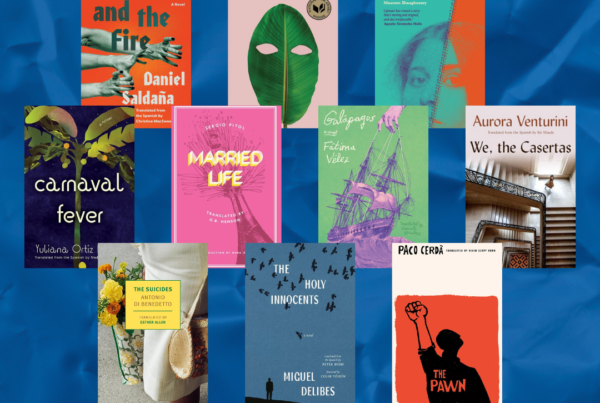
- The Dance and the Fire, by Daniel Saldaña París, translated by Christina MacSweeney, published by Catapult
- We Are Green and Trembling, by Gabriela Cabezón Cámara, translated by Robin Myers, published by New Directions Publishing
- Cautery, by Lucía Lijtmaer, translated by Maureen Shaughnessy, published by Charco Press
- Carnaval Fever, by Yuliana Ortiz Ruano, translated by Madeleine Arenivar, published by Soft Skull Press
- Galápagos, by Fátima Vélez, translated by Hannah Kauders, published by Astra House
What the jury says:

Carnaval Fever
Yuliana Ortiz Ruano’s simultaneously sly and unblinking debut novel takes us–-with salsa, champeta, guaguancó, and currulao––into the family of Anhoia, a young girl growing up in Esmeraldas, Ecuador. We meet her gaggle of unmarried aunts, whose charms and energy so thoroughly animate Anhoia’s life that the male violence they protect her from is all the more shocking when it arrives. The musical syntax and informal Spanish would represent, to many translators, page after page of translation “problems.” But Madeleine Arenivar has sidestepped that framework entirely. She finds a deceptively easy-going, big-hearted English to keep pace with the book’s wide-eyed, street-smart style. In her hands, when it comes to language, there are no problems––there’s only joy.

Cautery
Lucia Lijtmaer’s Cautery is a stunning achievement. At once an indictment of patriarchy writ large and a lamentation of grandiose geopolitical projects gone wrong, the narrative follows the lives of two women: 17th-century Deborah Moody in colonial Massachusetts Bay and a contemporary Catalan woman now living in Madrid surveying the wreckage of her relationship to a superficially progressive hipster with political aspirations. In her richly nuanced translation, Maureen Shaughnessy brings the protagonists’ voices to life. With skilled manipulation of tone and register she teases out the parallels Lijtmaer draws between the misogyny of yore and that of today. Shaughnessy’s verbal control is deft, as at ease with takedowns of the narcissistic demographic hanging out in Barcelona wine bars as she is convincing in the portrayal of repressive colonial existence, the two equally stifling worlds the protagonists inhabit. Women, regardless of time or place, are revealed to be essentially the same: objects of the male gaze, removed of power and agency, to be shaped at man’s will. A truly stellar translation.

Galápagos
A manic claustrophobia permeates the pages of Galápagos, a novel in which everyone dies. Loosely inspired by the life of gay Colombian artist Lorenzo Jaramillo, who passed away in 1992, Galápagos captures the profound grief, open-sore decay, and almost religious mystery of the early AIDS crisis. This debut from Fátima Vélez arrives fully incarnated in English thanks to its translator, Hannah Kauders, who matches Vélez’s unending, unnerving sentences swerve for swerve. Much like the otherworldly voyage that takes up the second half of the novel, Kauder’s translation is a vivid surprise, leaving us unmoored again and again, cruising between life and death, the devil and the deep blue sea.

We Are Green and Trembling
Drawing inspiration from the life of Antonio de Erauso, a Basque explorer assigned female at birth, Gabriela Cabezón Cámara’s We Are Green and Trembling, translated by Robin Myers, sounds the depths of Spanish colonialism to posit a more fluid and interconnected way of being in and with the world. As he cares for (and is cared for by) two Guaraní girls he rescued from enslavement and the animals that accompany them, Antonio writes letters back to his aunt at the convent from which he escaped; between these missives and chapters detailing the brutal conquest to which his journey is tied, this novel explores the long reach of colonial violence, the artificial constructs of both history and gender, and the natural world as a complex web of subjectivities we can no longer afford to ignore. In language as lush and taloned, as hypnotic and bracing and textured as the jungle depicted in its pages, Robin Myers conveys the events and emotions of We Are Green and Trembling with a remarkable sense of immediacy, while preserving the baroque flourishes that lend the work its historical air. An extraordinary novel, spirited and generous, presented in an English translation that is a work of art unto itself.

The Dance and the Fire
The Dance and the Fire recounts a brief period in the lives of three estranged schoolfriends-slash-ex-lovers in Cuernavaca, now temporarily reunited. Of course, it is also a pretext to reflect poignantly on ecological catastrophe (the titular fire), mental illness, patriarchy and the role of art among other things. Each character recounts their version of the past and present in first-person narrations, compellingly tinged with anxiety and malaise, which unfold in overlapping layers to reveal the ties and the wounds binding the group together. Christina MacSweeney is masterful in rendering the three voices: Natalia, a choreographer who lives with her pompous and much older (ex-professor) lover; Erre, an unsuccessful filmmaker, back from Mexico City and nursing wounds from his recent divorce and mysterious physical ailments; and Conejo, a semi-hermit caretaker for his father and potential conspiracy theorist. MacSweeney’s translation moves deftly between each of their voices, finessing registers and moods with ease. Natalia is a particular joy, her reflections ranging from 17th-century Swedish witch hunts and medieval dance epidemics to 21st-century takedowns of the pomposity of local arts patronage. A story for our time.